
October 29, 2026 · 6 min read
Unlocking ChatGPT for Business: Workflows Beyond Email
Move beyond drafting emails. Learn how to use ChatGPT for strategic operations, customer persona simulation, data cleaning, and competitor analysis.
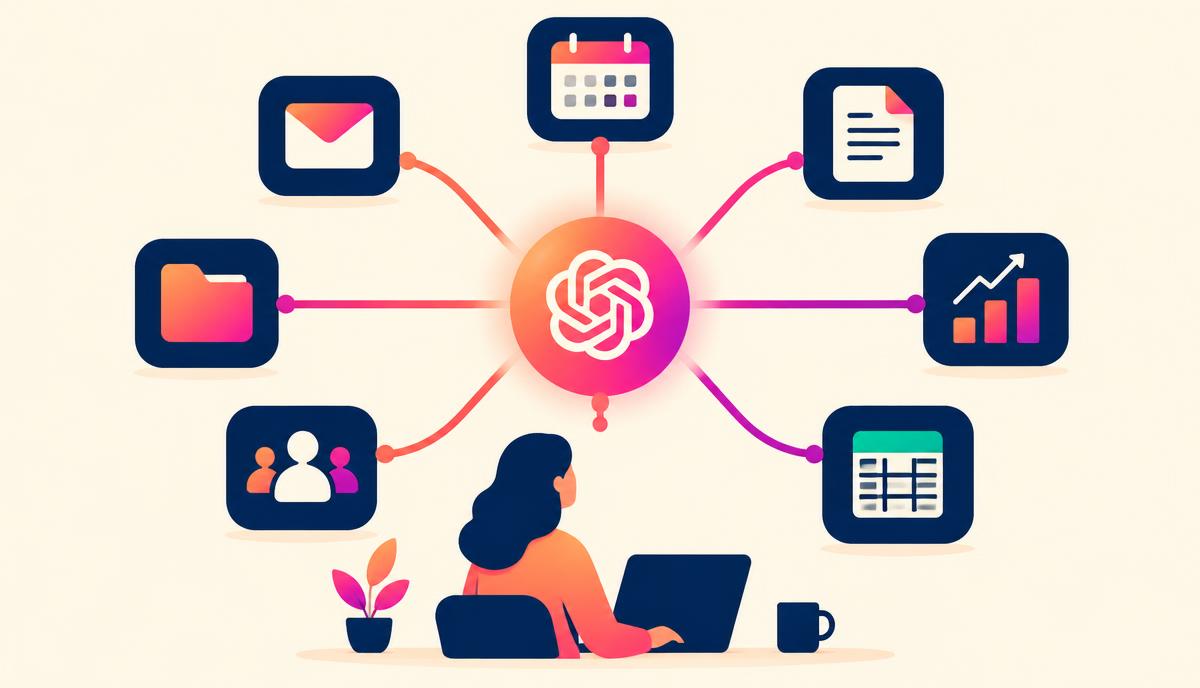
Most professionals use ChatGPT as an over-qualified copywriter. They use it to clean up messages, draft cold outreach, or write social media posts. While these tasks save time, relying on generative AI solely for basic text generation misses the true value of chatgpt for business. When integrated deeply into your strategic workflows, conversational AI becomes a powerful operational engine, an analytical partner, and an interactive testing ground.
To scale your operations and build a highly efficient business, you must move beyond the inbox. By applying structured frameworks, you can use generative AI to run simulations, analyze competitive landscapes, clean unstructured data, and stress-test your financial assumptions.
Leveraging ChatGPT for Business Strategy: Simulating Customer Personas
One of the most valuable yet underutilized applications of generative AI is market research simulation. Instead of guessing how your target audience will react to a new offer, landing page, or product feature, you can program ChatGPT to act as a highly specific buyer persona.
This is not about asking generic questions like, "What does a small business owner want?" Instead, you build a comprehensive profile using real customer qualitative data, review mining, and demographic profiles.
The Persona Simulation Workflow
To run an effective simulation, feed the model a highly structured prompt that establishes the persona's constraints, biases, and goals.
Use this system prompt framework to set up your simulator:
- Role: Act as [Name], a [Job Title] at a [Company Size] company, earning [Income/Revenue].
- Context: You are struggling with [Specific Pain Point, e.g., high churn, manual data entry]. You have a skeptical attitude toward new software tools because you have been burned by complex setups in the past.
- Task: I will present a new offer to you. Analyze it from your perspective. Point out what makes you nervous, what excites you, and what would prevent you from buying.
- Output Constraint: Do not break character. Respond with raw, honest feedback. Do not be polite.
Once the persona is established, paste your landing page copy or offer description. You will receive critique that highlights friction points, confusing jargon, and unaddressed objections. This allows you to refine your messaging before testing it in the wild, saving valuable ad spend and development time.
Transforming Competitor Intelligence with ChatGPT for Business Analytics
Keeping up with competitor positioning, pricing changes, and feature updates is a manual bottleneck. You can use ChatGPT to synthesize messy competitor data and generate structured strategic reports.
By feeding public data—such as competitor landing pages, feature lists, pricing matrices, and customer reviews—into the model, you can instantly extract gaps in the market.
Building a Feature Gap Matrix
To analyze your competition, collect unstructured data from three competing websites. Paste the text into the model and use the following prompt:
"Analyze the attached text files containing service offerings for Competitor A, Competitor B, and Competitor C. Create a markdown table comparing our business (which offers [Your Unique Value Proposition]) against these competitors. Focus on: Target Audience, Primary Value Proposition, Pricing Model, and Missing Gaps in Their Offerings."
Here is an example of the structured analysis you can expect from this workflow:
| Competitor | Target Audience | Value Proposition | Pricing Structure | Key Vulnerability / Gap |
|---|---|---|---|---|
| Competitor A | Enterprise IT Teams | High-security cloud storage | Annual contract, custom pricing | Complex onboarding; lack of support for small teams |
| Competitor B | Freelancers & Creators | Simple, visual file sharing | Cheap monthly subscription | Lacks advanced security and collaboration tools |
| Competitor C | Mid-market agencies | Client portal with file sharing | Tiered user-based pricing | Overbuilt feature set; high learning curve |
| Our Business | Mid-market agencies | Secure, fast client portal | Flat-rate monthly pricing | Lower brand awareness compared to Competitor C |
This structured table allows you to quickly spot where your competitors are weak. If Competitor A is too complex and Competitor B is too simple, you can position your offer precisely in the middle, using data-driven insights rather than guesswork.
Automating Messy Data Extraction and Formatting
Every business deals with unstructured data. This includes transcriptions from client onboarding calls, customer support logs, raw survey responses, or messy CRM notes. Cleaning this data manually is tedious.
ChatGPT excels at pattern recognition and structural transformation. You can feed it unstructured text and command it to extract specific variables into clean formats like CSV, Markdown, or JSON.
The Raw Transcript Cleaning Workflow
Suppose you have a 45-minute audio transcript of a customer feedback interview. The transcript is filled with filler words, tangents, and disorganized thoughts. Use this workflow to extract actionable insights:
- Paste the raw transcript into ChatGPT.
- Apply this extraction prompt:
"Read the transcript below. Extract every mention of product bugs, feature requests, and competitor names. Present these in three distinct bulleted lists. For each item, include a one-sentence context quote from the speaker. Do not summarize or synthesize the overall conversation; only extract the raw data points requested."
This workflow turns a messy, unreadable wall of text into a clean action list for your product or customer success team in seconds. By bypassing manual note-taking, you accelerate your feedback loop and resolve customer pain points faster.
Scenario Planning and Operational Modeling
Financial and operational modeling often requires specialized spreadsheet skills. If you use ChatGPT Plus or Enterprise, you can leverage the built-in advanced data analysis capabilities (Code Interpreter) to stress-test your business assumptions.
Instead of manually building complex "what-if" formulas in Excel, you can upload your current financial data or operational metrics and ask the model to run simulations.
Running a Capacity Simulation
If you run an agency or service business, you need to know when to hire your next team member. You can upload a simple CSV of your team's current client workloads and project pipeline, then run this prompt:
"Based on this workload data, simulate our capacity for the next quarter. Assume we sign three new clients at our average contract size of 15 hours per month. At what point does our current team exceed 85% capacity? Which specific team members will experience the bottleneck first? Suggest a hiring timeline based on this data."
The model will write and execute Python code in the background to calculate your capacity curves, providing you with a narrative analysis and a clear, data-driven timeline for when you need to recruit your next team member. This shifts your operational planning from reactive fire-fighting to proactive scaling.
Best Practices for Implementing ChatGPT for Business Safely
To successfully deploy these advanced workflows across your organization, you must address data security and output quality.
- Protect Your Proprietary Data: Never paste personally identifiable information (PII), sensitive client data, or trade secrets into the consumer version of ChatGPT. If you are using ChatGPT for business-critical workflows, ensure you are on a Team or Enterprise plan where data training is turned off by default. Alternatively, manually toggle off "Chat History & Training" in your account settings.
- Establish a Prompt Library: Do not let team members write prompts from scratch every time. Build a centralized database of approved system prompts for persona simulation, data extraction, and competitive research. This ensures consistent outputs across your department.
- Apply the Human-in-the-Loop Rule: While ChatGPT can analyze data and draft complex scenarios, it does not possess human intuition or industry-specific context. Always treat its outputs as a strong first draft or a preliminary analysis that requires expert validation before execution.
Build Your AI-Driven Business Engine
Transitioning ChatGPT from a basic drafting tool to an operational partner is the key to building a lean, scalable business. By building systems for persona simulation, competitive intelligence, data cleaning, and scenario modeling, you free up your mental bandwidth to focus on high-leverage growth decisions.
If you want to master these advanced systems alongside like-minded leaders, we invite you to join the AI Magnet Community. Founded by award-winning entrepreneur and Fractional CMO Michelle Hummel, our free community offers the training, peer support, and templates you need to integrate AI intentionally and accelerate your business growth.