November 23, 2026 · 6 min read
Beyond Email: How to Use ChatGPT for Business Growth
Discover how to move beyond basic email drafting and use ChatGPT for market research, scenario planning, offer engineering, and operational SOPs.
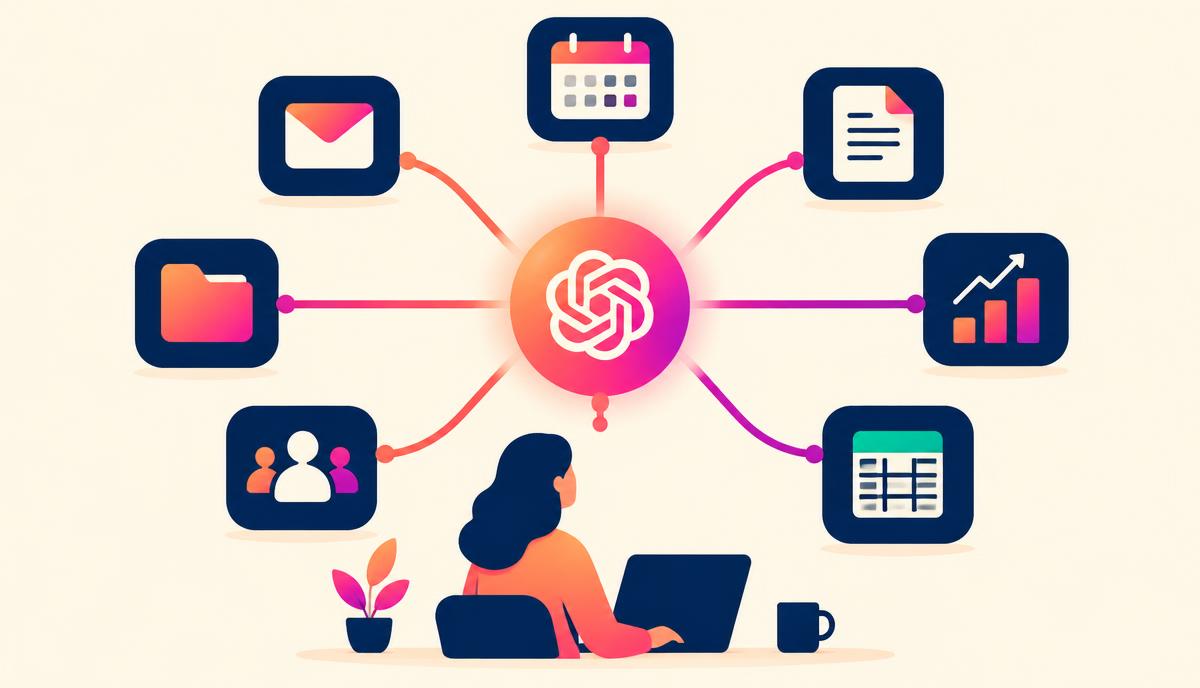
Most business owners use generative AI as a glorified copywriter or a quick email editor. While those tasks save minutes, treating ChatGPT for business as just a drafting tool misses its true strategic leverage. When integrated deeply into your operations, it serves as an analytical partner, a scenario planner, and an operational architect.
To build a highly defensible, lean business, you must move past basic text generation. By shifting your focus to high-leverage workflows, you can use AI to solve complex operational bottlenecks, analyze market gaps, and scale your personal capacity.
Strategic Market Analysis with ChatGPT for Business
Conducting qualitative market research often requires hours of tedious categorization. Business leaders must sort through customer survey responses, support tickets, and competitor reviews to find patterns. You can use ChatGPT to analyze this unstructured data in seconds, extracting critical insights that inform product development and marketing strategy.
To run this analysis, gather unstructured text data such as:
- Fifty of your recent customer support tickets
- Qualitative feedback from a recent post-purchase survey
- One-star and five-star reviews of your top three competitors
Paste this data into ChatGPT alongside a structured prompt that instructs the AI to look for patterns rather than summarizing the text.
The Qualitative Analysis Prompt
Use this system prompt to extract actionable insights from raw data:
'Act as a Senior Market Research Analyst. I am going to provide you with raw qualitative data from [specify source, e.g., competitor reviews]. Your goal is to analyze this data and categorize the findings into three distinct buckets: recurring emotional friction points, unexpected use cases, and specific feature gaps. For each category, provide a brief synthesis and list three concrete actions our product or service team should take to address these findings. Do not summarize the text; focus entirely on extracting non-obvious patterns.'
By executing this workflow monthly, you turn raw, messy qualitative data into structured strategic priorities. Instead of guessing why customers churn or what features competitors lack, you gain clear, evidence-based direction.
Scenario Planning and Financial Logic Checkers
Another high-value application of ChatGPT for business is stress-testing decisions before you commit capital or resources. Business leaders often fall victim to confirmation bias when launching a new product, hiring a team member, or changing a pricing model. You can use AI as a neutral, analytical sounding board to pressure-test your assumptions.
Rather than asking the AI if your idea is good, instruct it to actively find the flaws in your logic. This is known as pre-mortem planning.
| Business Scenario | ChatGPT Role | Key Prompt Directive |
|---|---|---|
| Raising Service Prices | Cynical Pricing Consultant | Identify three ways existing clients might push back and draft risk-mitigation strategies. |
| Hiring a New Department Head | Lean Operations Specialist | Analyze the hidden overhead costs and suggest alternative contractor structures. |
| Launching a New Offer | Skeptical Target Persona | Review the offer page and highlight every point of friction, confusion, or doubt. |
For example, if you are considering transitioning your service business from a project-based model to a monthly retainer, present your planned pricing, scope of work, and transition timeline to the AI. Instruct it to find the logical gaps: Where will scope creep happen? How might client retention be impacted during the transition? What cash flow bottlenecks will this create in month two?
This workflow does not replace professional financial planning, but it acts as a critical quality-control filter that catches expensive strategic errors early.
Offer Engineering and Tiered Pricing Models
Many consultants and creators struggle to package their intellectual property into scalable offers. They remain stuck in a time-for-money trap because translating their expertise into structured, tiered programs is challenging. ChatGPT for business can serve as an instructional designer and offer architect, helping you build systems that scale.
To build a new offer, you must provide the AI with your core methodology, your target audience, and the desired outcome.
Step-by-Step Offer Engineering Workflow
- Input Your Core IP: Provide a rough, unstructured brain dump of how you get results for your clients. This can be a rough transcript of a talk, bullet points of your process, or case study notes.
- Define the Constraints: Tell the AI the delivery format (e.g., a hybrid 8-week group program, a digital product, or a high-ticket mastermind).
- Request Tiering: Ask the AI to structure this IP into three tiers: a self-paced tier (do-it-yourself), a collaborative tier (done-with-you), and a premium tier (done-for-you).
Here is a prompt template to execute this strategy:
'I want to transition my bespoke consulting service into a structured, scalable program. I will paste my current consulting methodology below. Based on this methodology, design a three-tiered offer structure: 1) A self-paced digital course, 2) A group coaching program with community support, and 3) A premium high-ticket implementation service. For each tier, specify the target customer avatar, the primary value proposition, the suggested deliverables, and how to minimize my personal delivery hours while maintaining high client success rates.'
Once the AI generates the initial structure, you can iterate on specific components, such as drafting the curriculum modules for the middle tier or defining the exact boundaries of the premium service to avoid scope creep.
Advanced Operations: SOPs with ChatGPT for Business
Operational drag kills small businesses. As your team grows, you spend more time explaining how to do tasks than actually growing the business. Creating Standard Operating Procedures (SOPs) is the traditional solution, but writing them is incredibly time-consuming.
You can streamline this process by combining simple screen recording tools with ChatGPT for business. This workflow allows you to generate comprehensive, professional SOPs in minutes without typing a single word of instruction.
The Voice-to-SOP Workflow
First, record a quick screen-share or a voice memo of you performing the task. Talk out loud as you work, explaining why you are clicking certain buttons, where you find specific files, and what common mistakes to avoid. Don't worry about being polished; natural, messy speech is perfectly fine.
Next, download the transcript of your recording. If your screen recorder doesn't generate transcripts, run the audio file through a transcription tool.
Finally, paste the raw, unedited transcript into ChatGPT with the following instructions:
'The text below is a raw, conversational transcript of me performing a business process. Please transform this raw transcript into a highly polished, professional Standard Operating Procedure (SOP). Structure the SOP with the following clear sections:
- Objective: What does this process achieve?
- Prerequisites: What tools, access, or files are needed before starting?
- Step-by-Step Instructions: Write clear, numbered action steps. Use bold text for key interface elements and inputs.
- Quality Standards: What does a successful outcome look like?
- Troubleshooting: What common errors occur, and how do you fix them?'
This simple operational workflow transforms a messy five-minute brain dump into a clean, repeatable training asset that you can immediately hand off to a virtual assistant, contractor, or new team member. It eliminates the operational bottleneck of documentation and allows you to build a reliable training library quickly.
Moving from Tactical Drafts to Strategic Systems
The businesses that thrive in the AI era are those that view artificial intelligence not as a writing assistant, but as an operational system. By moving ChatGPT out of your email inbox and into your strategic planning, market research, offer development, and process documentation, you unlock exponential leverage.
Treat the AI as an intelligent partner that requires context, constraints, and clear objectives. The quality of your prompts and the structure of your workflows will dictate the value of your outputs. Stop using AI to write generic emails, and start using it to build a scalable, resilient business machine.
If you want to master these advanced workflows alongside other growth-minded business leaders, join the AI Magnet Community. Inside our free community, founded by certified AI Integration Specialist Michelle Hummel, you will get access to actionable training, proven prompt libraries, and collaborative discussions designed to help you integrate AI intentionally and scale your business.